
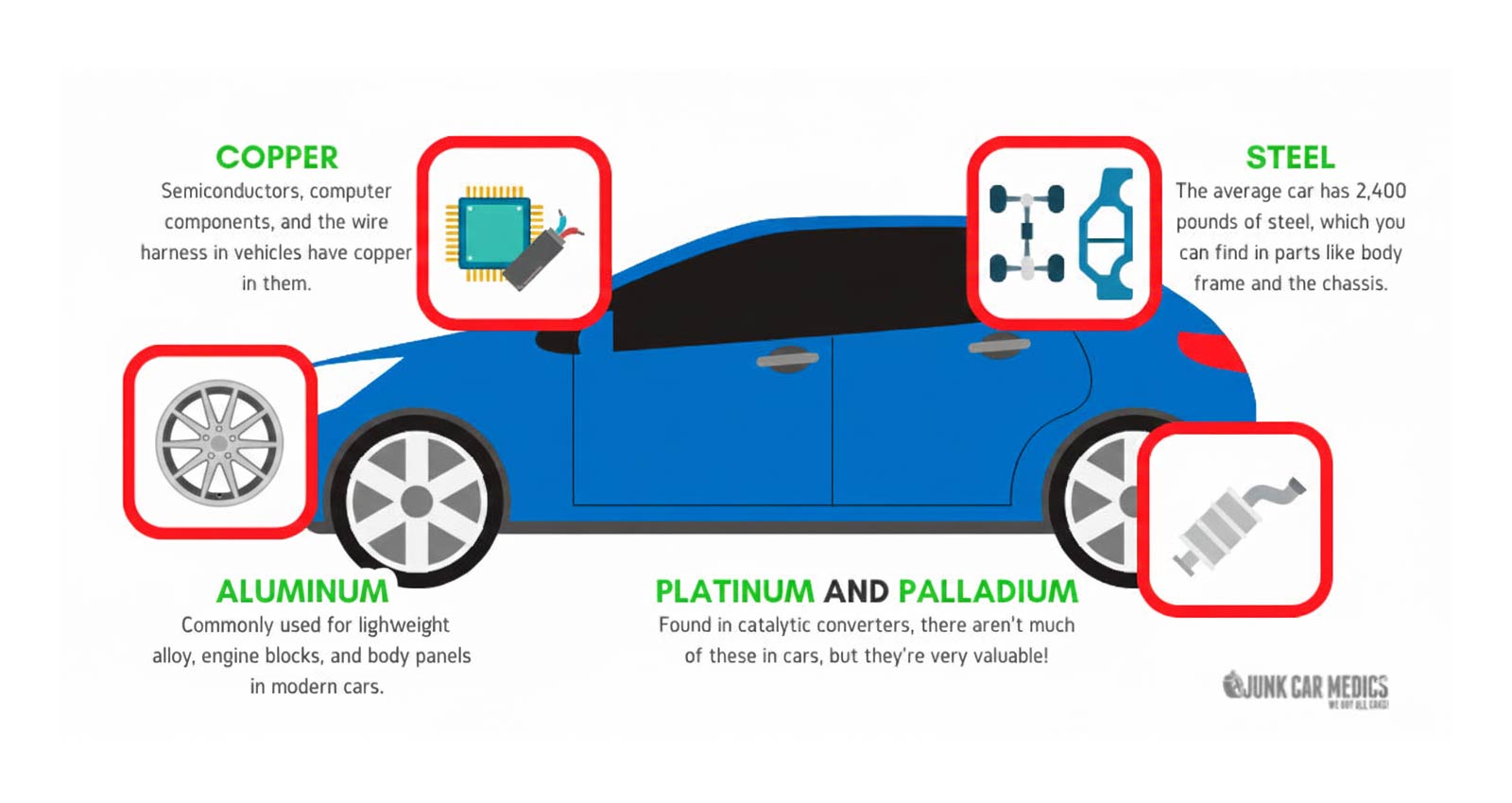
If you are trying to figure out how much your car is worth for scrap, the price comes from the vehicle's recyclable metal value, not its resale value. Even if your car will not run, is badly damaged, or is no longer roadworthy, it can still be worth money because recyclers pay for weight and metal content.
Most cars are worth about $150 to $500 for scrap based on metal value alone. Heavier SUVs and trucks often land in the $300 to $800 range.
Your exact offer depends on your car's curb weight, the local scrap price per ton, and whether key items like the catalytic converter, aluminum wheels, and copper wiring are still on the vehicle.
Scrap value estimate: curb weight × local scrap metal price (then adjusted for missing parts and valuable parts).
If you are asking "how much is a scrap car worth," this guide will help you estimate a realistic range before you accept an offer.
What Is Scrap Value?
Scrap value is the amount your car is worth when a recycler buys it for raw materials, not for driving, repairing, or reselling. A buyer pays scrap value based on what they can recover from the vehicle after it is processed.
In most cases, scrap value is based on vehicle weight and the current scrap metal price in your area. If your vehicle has high-value recyclable parts, the buyer may also add value for those items.
What "Raw Materials" Means
Raw materials are the recyclable commodities inside your car that a scrap buyer can recover and sell. Most of a car's scrap value comes from three material groups: ferrous metal (mostly steel and iron), aluminum, and copper. Ferrous metal makes up most of the vehicle's weight, so it sets the baseline scrap value.
- Steel and iron (ferrous metal): The largest share of most vehicles by weight. This usually drives the base scrap price.
- Aluminum (non-ferrous metal): Common in wheels, radiators, engine components, and some body parts. Often worth more per pound than steel.
- Copper (non-ferrous metal): Found in wiring, alternators, starters, and electric motors. Valuable, but a smaller portion of total weight.
Cars also contain plastics, rubber, and glass, but these materials usually do not raise the payout the way metal does.
How Much Can I Get for Scrapping My Car?
The amount you can get for scrapping your car highly depends on its weight in metal. Heavier vehicles contain more recoverable metal, which increases scrap value. Below are estimated values by vehicle class and weight using rates of $130 to $210 per ton.
| Vehicle Type | Weight (lbs) | Base Scrap Value (Complete Vehicle) |
|---|---|---|
| Small Car | 2,400 - 2,800 | $160 - $290 |
| Mid-Size Car | 3,000 - 3,400 | $200 - $360 |
| Full-Size Car | 3,500 - 4,000 | $230 - $420 |
| Compact SUV | 3,200 - 3,800 | $210 - $400 |
| Mid-Size SUV | 4,000 - 4,800 | $260 - $500 |
| Full-Size SUV | 5,200 - 6,000 | $340 - $630 |
| Compact Truck | 3,800 - 4,400 | $250 - $460 |
| Full-Size Truck | 4,500 - 5,500 | $290 - $580 |
| Heavy Duty Truck | 5,800 - 7,000 | $380 - $740 |
| Minivan | 4,200 - 4,800 | $270 - $500 |
* Missing parts (especially the catalytic converter, wheels, battery, engine, or transmission) can reduce offers.
What Factors Influence the Scrap Value of a Car?
The main factors that affect scrap value are the vehicle's weight, metal composition, local scrap price per ton, completeness, high-value components, and location.
Vehicle Weight
Heavier vehicles usually bring more scrap value because they contain more recoverable ferrous metal. For example, a compact car may weigh around 2,500 lb (1.25 tons), while a full-size pickup may weigh around 5,000 lb (2.5 tons).
Metal Composition
Metal composition affects scrap value because buyers pay different rates for different metals. Aluminum and copper often raise value because they usually pay more per pound than steel.
Local Scrap Metal Price Per Ton
Your local price per ton changes by region and by week. In most areas, scrap car prices generally range from $130 to $210 per ton depending on your region, the time of year, and current market conditions. Use our scrap car prices per ton page to see the current range for your area.
Vehicle Completeness
Completeness changes the offer because missing parts reduce recoverable materials and remove valuable items. Missing an engine, transmission, wheels, battery, or catalytic converter often lowers what a buyer can pay for a scrap vehicle or junk car.
High-Value Components
High-value components can increase the offer when they are present and intact. Catalytic converters, aluminum wheels, and batteries are common examples.
Location
Location affects scrap value due to local demand, yard competition, and hauling costs. Some regions pay more because buyers need inventory or have better downstream pricing.
How to Estimate the Scrap Value of Your Car
Most scrap offers start with a weight-based estimate. The buyer then adjusts the offer based on parts, condition, and pickup cost.
To estimate your vehicle's scrap value, follow these steps:
- Find your vehicle's curb weight using our vehicle weight lookup tool.
- Check your local scrap price per ton on our scrap car prices per ton page.
- Calculate the base value by multiplying your weight (in tons) by the local price per ton.
- Adjust the estimate based on missing parts and high-value items like the catalytic converter, battery, or aluminum wheels.
Simple formula:
Automobile scrap value estimate = (vehicle weight in tons) × (local price per ton) ± (parts and pickup adjustments)
Example: If your car weighs 3,500 lb (1.75 tons) and your local scrap price is $165 per ton, the base scrap value starts around $288.75. If the catalytic converter and aluminum wheels are present, a buyer may increase the offer. If those parts are missing, the offer often drops.
Why Scrap Value Changes
Car scrap value changes because scrap metal prices change. Steel, aluminum, and copper prices move based on supply, demand, and local yard pricing. That is why two offers for the same car can be different if they are given on different days or by different buyers.
What Scrap Value Is Not
- Scrap value is not resale value: It does not reflect what your car would sell for if it still runs and drives.
- Scrap value is not "repair value": It ignores what the car could be worth after repairs.
- Scrap value is not trade-in value: Dealers price trade-ins using resale demand and reconditioning costs, not metal weight.
Note: People often say "salvage value," but salvage can include repairable vehicles. Scrap value refers to recycling value based on materials and recoverable components.
Common Questions About The Scrap Value of a Car
How Much Do You Get For Scrapping a Car?
Most complete junk cars scrap for $200 - $500 based on weight, with heavier vehicles like trucks and SUVs worth more. A typical sedan (3,000-3,500 lbs) currently sells for $270-$420. The actual offer you receive depends on your location, vehicle condition, and current metal prices.
How Can I Check My Car's Scrap Value Online?
Use our scrap car value calculator to estimate your car's scrap value based on weight and condition. For an exact offer, contact local scrap yards or use our free quote tool. Remember that online estimates are approximations — final offers depend on in-person vehicle inspection.
Do All Scrap Yards Pay The Same Price?
No. Scrap yard prices can vary significantly based on their overhead costs, proximity to steel mills or export ports, current inventory levels, and business model. It pays to call 2-3 yards for quotes. However, prices typically fall within 10-15% of each other in the same region.
When Can I Get The Best Scrap Car Price?
Scrap prices are typically highest in spring (March-May) when construction activity increases steel demand. Prices often dip in winter months. However, waiting for "perfect timing" rarely makes a significant difference — we're talking $20-50 on a typical car.
What's A Car Shell Worth In Scrap?
A car shell (body only, no engine, transmission, or drivetrain) is worth roughly 45-55% of a complete car's scrap value. For a mid-size sedan shell, expect $150-$230. The remaining value comes purely from the steel and aluminum in the body.
Does My Car Need To Run To Scrap It?
No. Non-running vehicles are scrapped every day. While a running vehicle may command a small premium (the engine has resale value), non-running cars still contain the same amount of scrapable metal. Many buyers offer free towing for non-running vehicles.
Do I Need A Title To Scrap My Car?
Requirements vary by state. Most states require a title or valid registration. Some accept alternatives like a bill of sale, lien release, or allow you to obtain a duplicate title. Cars without proper documentation typically receive lower offers due to additional paperwork requirements.